
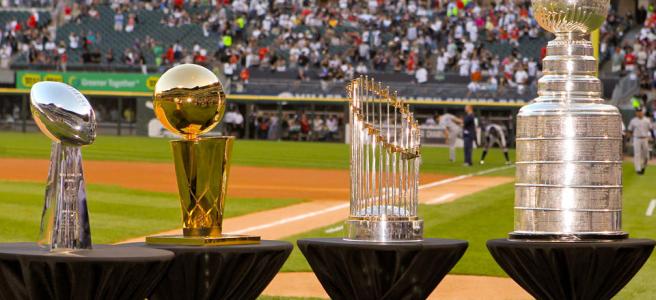
Back to back championships can be so exciting. Michael Jordan leading the Bulls to not just one ring, but six across two three-peat runs in the 90’s was absolutely incredible. Troy Aikman and the Cowboys got three Lombardi trophies in four years, firmly establishing the quarterback’s eventual spot in the Hall of Fame. Those are memorable eras in sports history, and regardless of what team you like you have to appreciate the talent that those teams had. But sometimes seeing the same teams in the championship games year after year gets old. I think I speak for everyone when I say if Golden State goes to the Finals again I’m not even going to watch the series, it’s just ridiculous at this point.
What’s the difference between Golden state now and MJ’s Bulls? The past four NBA finals have been Golden State vs Cleveland; the outcome is predictable to the point there is no drama worth tuning in for. In the 90’s though, the Bulls faced the Lakers, Trail Blazers, Suns, SuperSonics, and Jazz. At least there was a chance that a new opponent might dethrone the Bulls, but when the same two teams face-off every year it doesn’t really matter who wins. These repeat championship contenders are an indication that the league isn’t balanced. But what does it mean to be balanced? Every sport has dominant teams, but some seem worse than others when it comes to a couple clubs having absolute ownership over the game.
So what does a “balanced” league look like? For me, a balanced league is one where half of the teams that reach the playoffs are returning members, and half did not make it the previous season. If the entire postseason lineup is different every year then every team is performing almost exactly the same. While this is “truly balanced”, it indicates there is no skill to the game; you are advancing on random chance. Conversely, if the lineup is exactly the same as the year before then we should expect the exact same outcome so that’s also bad. Thus, half-and-half is a happy medium where we can expect a couple teams to advance “as usual” but with the threat of an underdog to take their place instead. Let’s apply this standard to the major sports leagues in the United States (MLB, NBA, NFL, NHL) over the past ten seasons.
The numbers below reflect the number of teams returning to the playoffs from the previous year. I hand-collected the data which can be viewed here.
| Season | MLB | NBA | NFL* | NHL |
|---|---|---|---|---|
| 2009** | 4 | 13 | 5 | 11 |
| 2010** | 3 | 12 | 6 | 10 |
| 2011** | 4 | 11 | 7 | 13 |
| 2012 | 4 | 14 | 6 | 12 |
| 2013 | 5 | 12 | 8 | 11 |
| 2014 | 5 | 11 | 7 | 11 |
| 2015 | 4 | 12 | 7 | 9 |
| 2016 | 5 | 11 | 8 | 11 |
| 2017 | 5 | 12 | 6 | 9 |
| 2018 | 7 | 12 | 4 | 9 |
| Average: | 4.6 | 12 | 6.4 | 10.6 |
| Expected: | 4.7 | 8 | 6 | 8 |
| Score: | 0.9787 | 1.5 | 1.0666 | 1.33 |
*The NFL seasons are actually 2008-2017, since the 2018 NFL Playoffs have not happened yet.
**The 2009-2011 MLB seasons only had one Wild Card team per league, so the expected average over this period is less than 5.
What does this mean?
Anyone who watches basketball shouldn’t be surprised; the NBA has clearly been dominated by a select number of clubs for a long time, and it only seems to be getting worse. The current salary cap system implemented in 2016 has done little to nothing to shake up the league. The “soft cap” nature means that super-power teams (like the Lakers) are still able to give out astronomically large contracts to as many generational talents as they want (like LeBron), and with luxury tax exemptions teams that are already profitable or are located in highly populated markets (such as LA) benefit more.
The NHL is the next worse, but they’ve been getting better lately with the exception of 2016. One thing that helps shake up playoff pictures is more competition, which is just what happened when the Vegas Golden Knights were introduced to the league last year and made a historic run right to the Stanley Cup Finals. They did fail to win the Cup, keeping the Colorado Avalanche’s record of the only expansion team to win the trophy in their inaugural year intact (although they were technically a relocated Quebec Nordiques team). Nonetheless, the Knights are a great example of how new teams are good for revitalizing leagues, and this will only continue as the NHL votes next week to potentially add another team in Seattle. Futhermore, the league introduced a “hard cap” in 2013 which is more effective at keeping large markets in check.
Right in the middle of the road is the NFL, and this did surprise me. It seems like we have a handful of dynasties that will continue to shape the race for the Lombardi for years to come, and we do…in the AFC. The AFC continues to be controlled by the few, namely the Patriots, Steelers, and rising Chiefs, while the NFC is an absolute free-for-all. In fact, the NFC only had one returning team last winter. This is interesting as the NFL has not only a hard cap ceiling but also a cap floor, forcing every team to spend about the same amount of money over a four-year period.
The sport that ended up being not only the closest to balanced but the only one to have more teams changing per season than staying? Baseball. I attribute this to two distinct reasons: the MLB luxury tax and the way the game is played. I’ll start with the latter.
Baseball is a really stupid sport. I say that because ultimately it can be played with only three players: a pitcher, catcher, and batter. If the batters keep striking out, no other players are necessary. Hitting a major league-caliber pitch should be impossible, but these players practice for hours upon hours so they can get lucky enough to hit one hopefully 30% of the time (unless your name is Mike Trout and you hit pitches whenever you please). There are so many factors that go into getting a hit, successfully fielding the ball at throwing speeds most people can only dream of accomplishing themselves, and you have to do it for hours. It doesn’t matter how long you’ve been playing, no ties are allowed. So long story short while these players are talented and some are clearly better than others, a lot of the game depends on luck.
Going back to the luxury tax, this system is similar to the NBA’s agreement except there are no special exceptions that a team must meet to break the cap; if you have the dough to pay the taxes above the threshold then you can buy whoever you want. But for the most part, teams don’t. Since the system was implemented in 2002, only eight teams have gone above the threshold, and only two have made serious payments to the league: The New York Yankees and The Los Angeles Dodgers. The boys in pinstripes have payed luxury taxes every year since the agreement began and have only one World Series to show for it, and the Dodgers have back-to-back losses, whereas the Red Sox have spent a sixth-of the amount of LA and have four rings in that time frame. The moral of the story is blowing all your money on all-stars isn’t a surefire way to take it all.
So congratulations, MLB! You’re the most balanced Big 4 league, for now. Once Tom Brady retires the NFL might be coming for you.
Where do we go from here?
Ultimately none of this means anything. It’s a weird statistic that I made up, and every sport is different so applying a blanket method to try and balance out super-teams with the underdogs will fail. I am an advocate for the NFL’s method though. I think this will have the most prominent effects in the long run and is better than allowing teams to buyout if they choose like the MLB, but they did win this “competition” so maybe I’m wrong. Let me know what you think!

 Let's Talk Sports